

Why the Hummingbird
The bird that moves forward, even when it goes back.
The hummingbird in our mark was not chosen because it is pretty. It was chosen because of how it flies. No other bird moves the way it does, and the way it moves is the way people move through change.
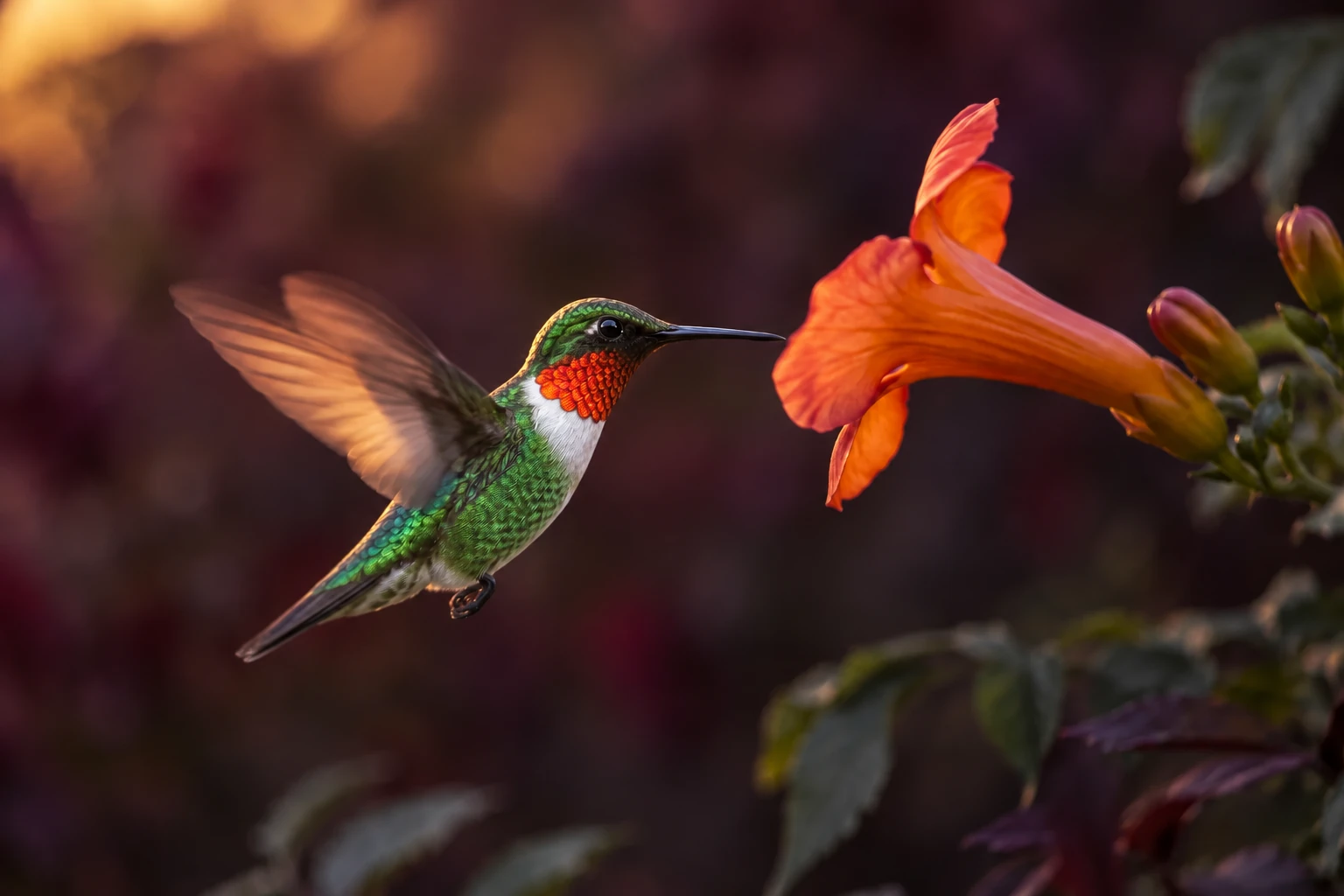
Most of us picture change as a straight line from where we are to where we want to be. It almost never works that way. People pause, step back, adjust, and move again. The hummingbird does all of that in flight, and it is still one of the most precise and capable fliers in nature.
What the hummingbird can do
01
It holds its position.
Hummingbirds are the only vertebrates capable of sustained hovering. They can stay in one place in mid-air while they read what is in front of them.
In a changeBefore you move, you need an honest read of where you are. Holding still to see clearly is a skill, not a delay.
02
It flies backward, then forward again.
Backing away from a flower is a normal part of how a hummingbird feeds. Research on Anna's hummingbirds found that sustained backward flight costs no more energy than forward flight at the same speed.
In a changeGoing back is part of the work. You return with new information, not to the start. A step back is not a failure.
03
Both strokes carry it.
Most birds get their lift from the downstroke. A hummingbird produces power on the upstroke as well, which is what gives it such precise control.
In a changeEvery motion counts in a change: the effort that moves you forward and the effort that keeps you steady.
04
It prepares for the long crossing.
Migrating ruby-throated hummingbirds fly 18 to 20 hours without stopping to cross the Gulf of Mexico, powered by fat stores they built in the weeks before.
In a changeLasting change is rarely one leap. It is built on preparation that happens long before anyone sees the result.
Change is not a straight line. Neither is the flight of a hummingbird. Both still get where they are going.
That is the idea behind the DO.ITChange™ Method: movement that is intentional, even when it is not linear.
Sources: Smithsonian's National Zoo and Conservation Biology Institute; National Audubon Society; Sapir and Dudley, Journal of Experimental Biology (2012).